

#186: Wilson.
Pilgrim letter #2.
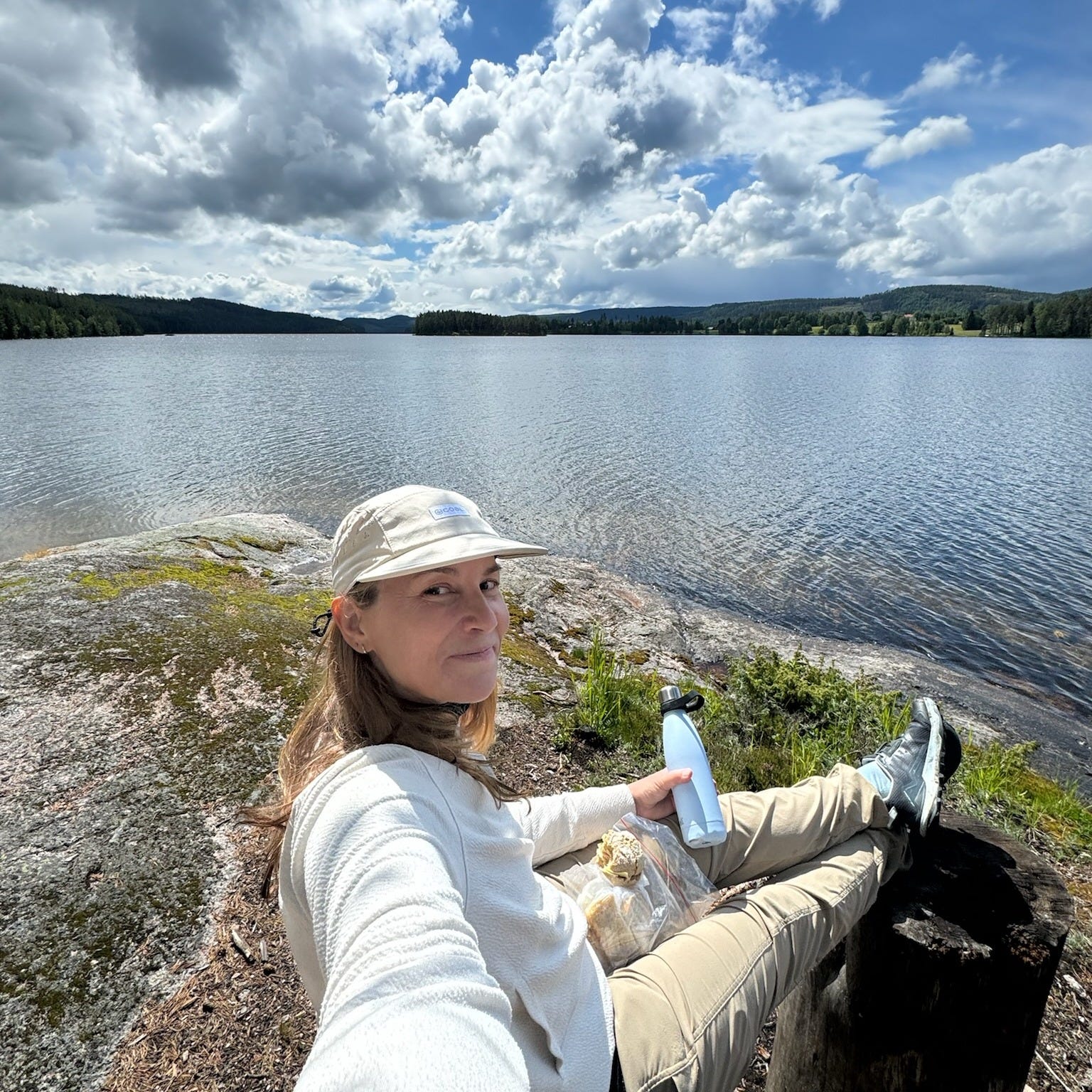
Last fall, I sent Ruben, my Scandinavian pilgrimage organizer, a note.
”I’m ready to pilgrim again!” I wrote, and then described my desire to carbon copy 2024’s journey.
“Same route???” he immediately responded.
Wait a second, is that judgement I’m reading in all the question marks? Doesn’t everybody love to repeat the same exact thing ad nauseum, to prove to themselves the first time wasn’t a fluke?
Hmm. Maybe that’s just me.
“I have three other routes you can do! There is so much else you can see. We cannot repeat!” the ever-blunt Dutchie informed me.
“Ok, well I see you have a Norway-only, south-to-north route to Trondheim on your website. I don’t want to start in Oslo, that’s too far. Maybe a little further up?”
“Yes, I just opened a route from Lillehammer. It will take 21 days. How does that sound?”
And in typical knee-jerk fashion, without a second thought or single lick of research, I responded: “I’m in.”
So there I was, picturing all those gently rolling Swedish hills, lakeside walks, logging roads, gentle grades that were long, yes, but eminently doable from pilgrimage 1.0.
Boy, was I wrong.
Day 1: Fine, sure, no problem. Some roadside walking and a manageable climb out of Lillehammer.
Day 2: Hold up, this is way hillier than I expected. And why are these trails no wider than a loaf of bread? And filled with rocks. Just 17km took me 8 hours.
Day 3: All of the above, only raining. Dorothy, we are not in Kansas anymore.
Was it going to be this level of survival mode day 4, 5, 6…..?
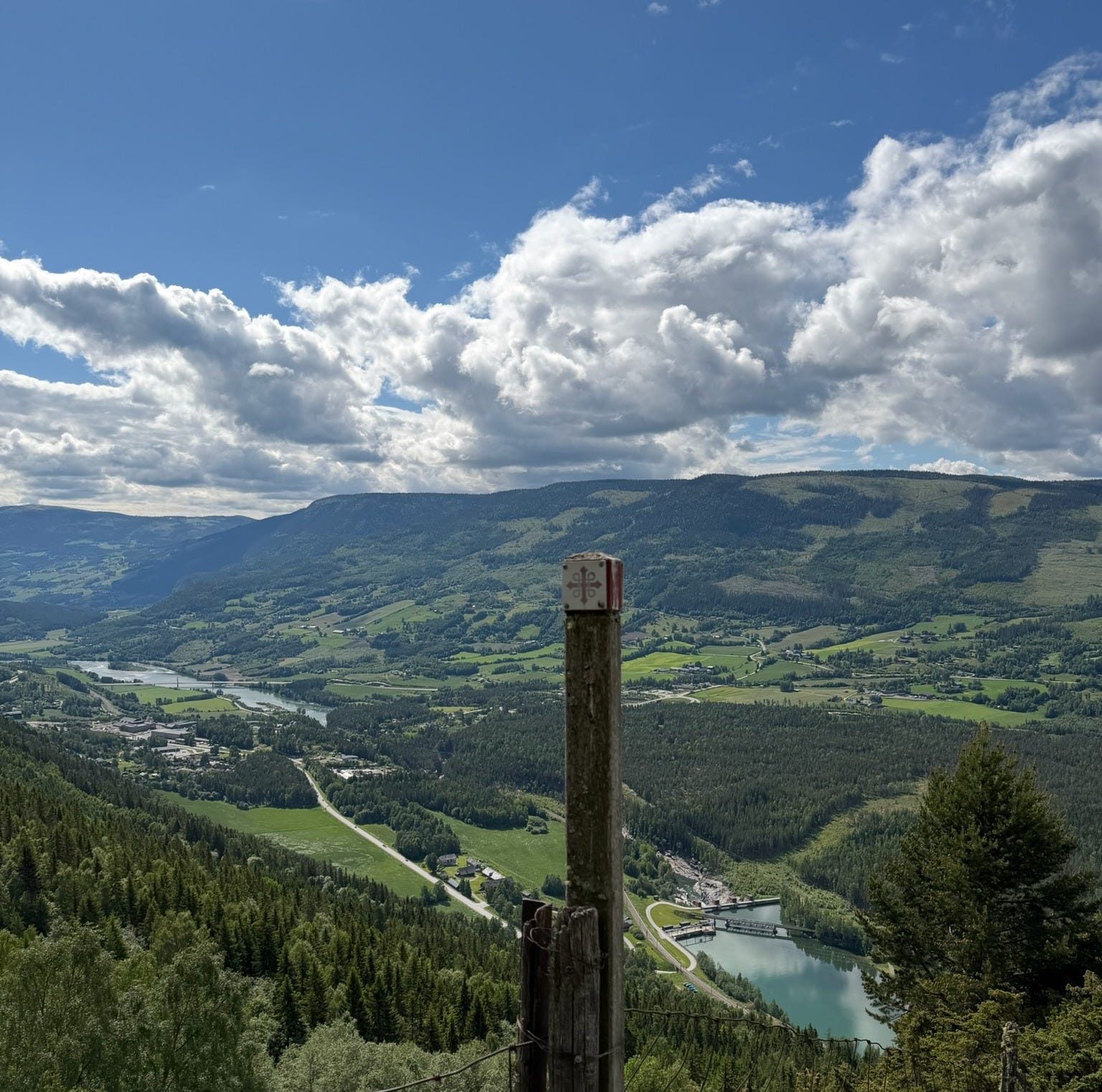
Of course there were incredible views, incredible food, incredibly nice Swiss, German, and Dutch pilgrims along the way. But the terrain was handing me my ass. Ascents so steep that I was mouth breathing for hours. Descents where I could not see my feet through the underbrush. Rinse and repeat.
By Day 6, I was pissed. At what, I couldn’t actually say. Certainly not Ruben, who spelled this all out in the trail notes he gave me far, far ahead of time. (Which I didn’t read.) I wasn’t mad at myself, either. After all, I wanted a challenge, I wanted to practice doing hard things. I’m even happy with my tendency to leap without learning everything ahead of time. I’m into the surprise, even when it’s nasty.
No, I was just the kind of mad that happens when life is freaking hard and it pisses you off. To top it all off, that evening’s accommodation was on the gritty side. My cheeseburger at the town’s solo cafe was consumed in sullen silence, no other customers to be seen.
While I was open to what pilgrimage 2.0 would bring me on the macro level, on the micro, I had happily pictured myself deep thinking, reading, and writing, just like pilgrimage 1.0.
Yeah, no.
I was so beat down by the time I reached my destination each day, rubbing two brain cells together to generate a thought or read a sentence any longer than ‘see Spot run’ was a non-starter. The Rebecca Solnit (Wanderlust) and Robert McFarlane (Is a River Alive) books I’d packed might as well have been the Chinese edition.
So, when I wasn’t walking I mostly stared into space. While elevating my feet.
Day 6 became Night 6 and I flip-flopped on my tiny top bunk, trying to get comfortable with my wafer-thin pillow in the never-dark Nordic summer ight. The needle on my internal fortitude dial was bouncing around “empty”. I pulled out my phone to trace the map and read the description for Day 7 — ‘more of the same’ was the theme.
I needed an attitude adjustment. Pronto.
So, as a man of action, I tossed around a few ideas. I briefly dreamed of levitation or a transporter beam, but quickly set those aside for my tried and true go-to’s for when things get dire:
Play #1: Expectation management
I started by reading Ruben’s directions for the next day carefully: there would be three super-sized elevation gains and losses. (That’s a pilgrim euphemism for big ass hills.) Ok, don’t love this, but the only way to the other side is through. So as I set out the next morning, I didn’t think about the whole trek, just the “elevation gain” in front of me. This way, rather than dreading them all (well, truth is I still did dread them, just a little less) I could tick each one off as I flattened them before they could flatten me.
Play #2: A carrot
This route is filled with guest houses and mountain lodges. Very few hotels. But the Thon Hotel Otta (which I kept calling the Thor hotel in my head, as one does) awaited me at the end. It was no Four Seasons, more Beaver Falls Holiday Inn vibes, but the thought of a room with my own bathroom (a luxury!) and a dinner buffet was like hope on a stick. A carrot dangling in front of me.
Play #3: Treats
I tend to want to keep stomping forward and wreck myself, rather than let myself take a break. To convince myself to take my pack off for 20 minutes, I needed an incentive. I had my daily cheese sandwich, but that was hardly inspiring. So I needed two treats for in between the three elevations (simple pre-school math). First up, instant coffee in a plastic jar, along with a mysterious yogurt and nut mix. I cannot convey the kind of Michelin-star experience this was. Heaven. One hill later, I stopped at a campground to purchase the most syrupy juice I could find along with a chocolate bar. It sounds disgusting writing about it. It was pure bliss consuming it.
As I rode the emotional and altitudinal highs and lows of the day, life handed me an unexpected boost as well, by way of the Tom Hanks movie Cast Away. (Ever wonder what you think about on the pilgrim path? There’s your answer.)
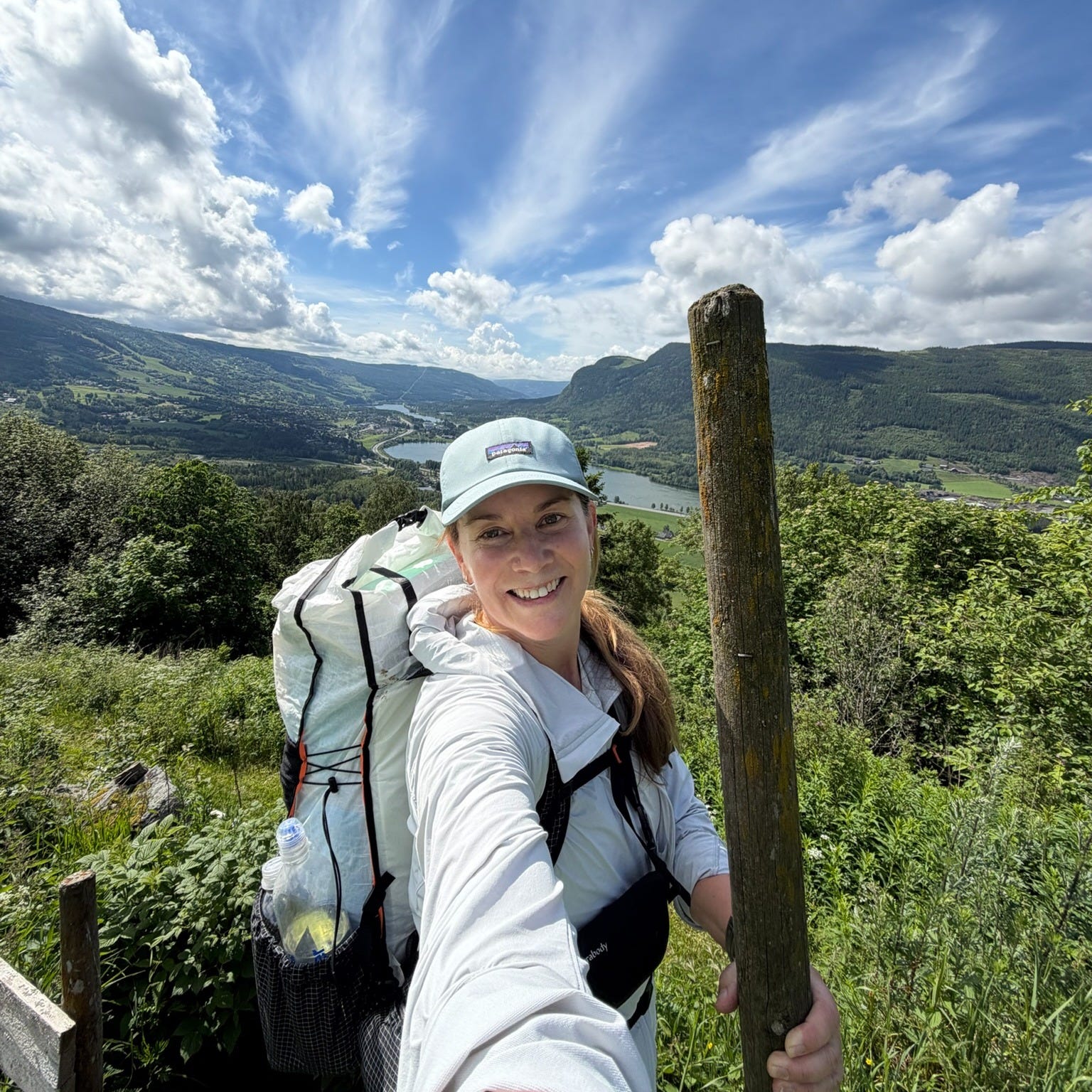
Midway through the second of the ascents and descents from hell, I picked up a stick. A hiking stick. It was hiding in some underbrush, whispering my name. Maybe a little help boosting me up or steadying me as I find my footing would make the day better? I’m not normally a hiking pole gal, but desperate times, desperate measures. It was a learning curve, that first kilometer with the stick in tow. By the second, I couldn’t believe I’d ever lived without this stick. Just like Tom on his desert island, his only companion a volleyball, I christened my stick by the same name: Wilson.
I’m not sure I would have made it without Wilson. Not just physically, mentally too. To have something to rely on, to help me, to literally hold in my hand gave me courage, safety, and support, just when I needed it. A mountain-made security blanket.
At the end of hour eight, I came down out of the hills to a gravel logging road, then a paved walkway, flat as a pancake and headed into Otta. I was almost there. The up-and-downs conquered, the treats consumed, the hotel on the horizon. As I reached the sidewalk, I was so tired I was dragging Wilson behind me like Linus with his blanket. I passed a fire station, its freshly mown grass dusting the concrete where my feet fell. Clearly no need for a walking stick. Still I could not let him go.
To get into town proper, I had to go through a tunnel under the Norwegian version of a highway. The change in light brought me up short, and for a second I saw myself fifteen minutes from now: sweaty, swollen, and filthy, carrying a big jagged stick, sidling up to the front desk clerk and asking for my room. It was time to let Wilson go.
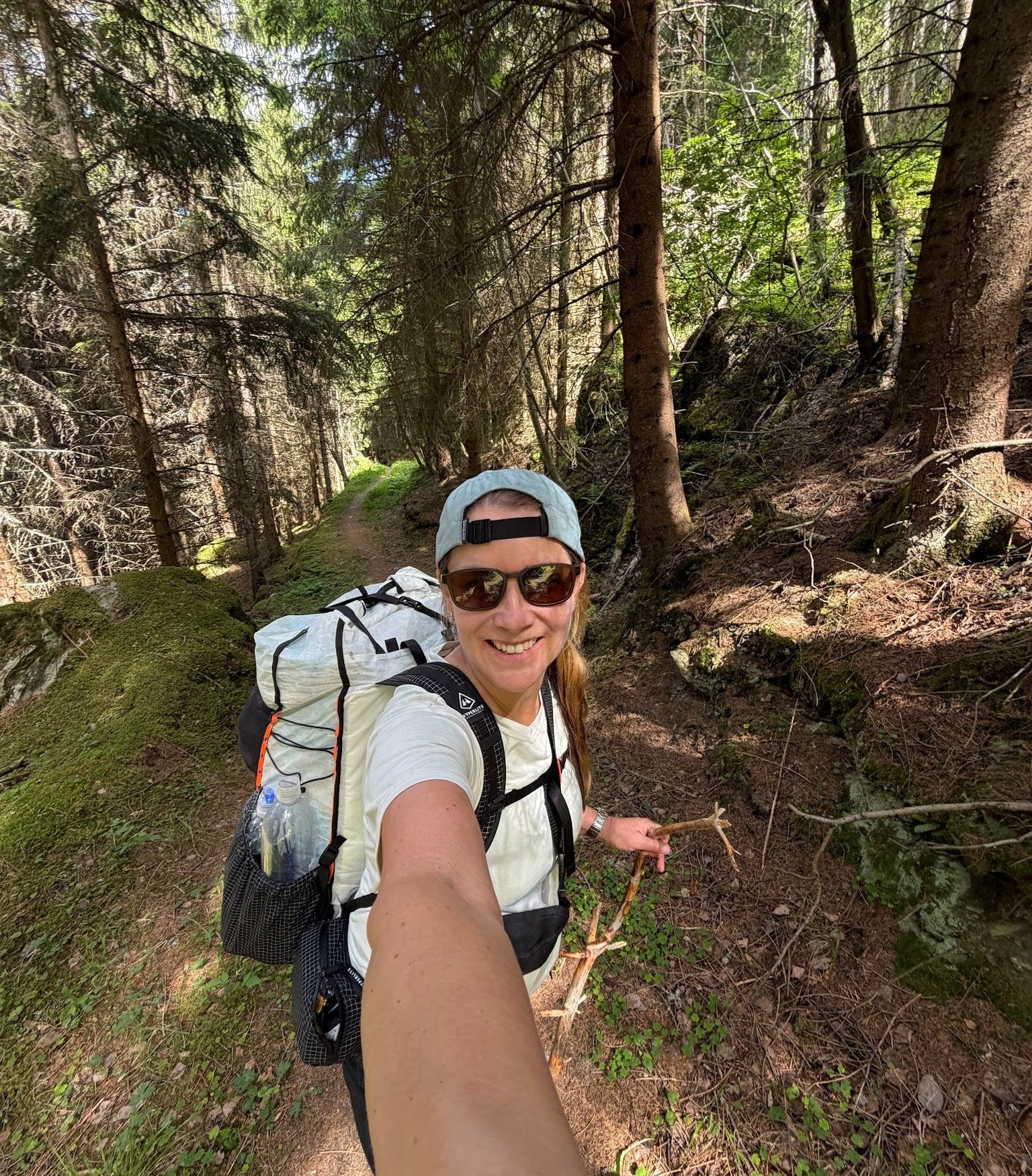
That’s what the pilgrim path teaches you. How to use your existing skills better, sure. But also how to find new ones, and then, when it’s time, how to leave those behind too.
In recovery,

P.S. I’ve made another video for the Loss Canon: The Books that Got Me Through. If you’re into books and/or videos, you can watch it right here:
Oh. Oh. Poor Wilson. My heart broke just a teeny tiny bit when you left him behind. And I realized how typical that is of me, when I read your final line. I hold on to things for much too long, whether it's clothes I had back when my husband was alive, or regrets about the relationship I dove into years after his passing. If you learn any let-it-go philosophies from the trail (only those having nothing to do with an animated movie), please share!
What a journey! Keep on going!